A wedding budget that holds: where the money actually goes
How the spend really divides, why cost per head is the only number that matters, and the five costs couples forget until the invoice arrives.

The short version
- Budgets break because the guest count moves, and most big costs are multiplied by it.
- Roughly half goes to the venue, food and drink; keep about a tenth back as contingency.
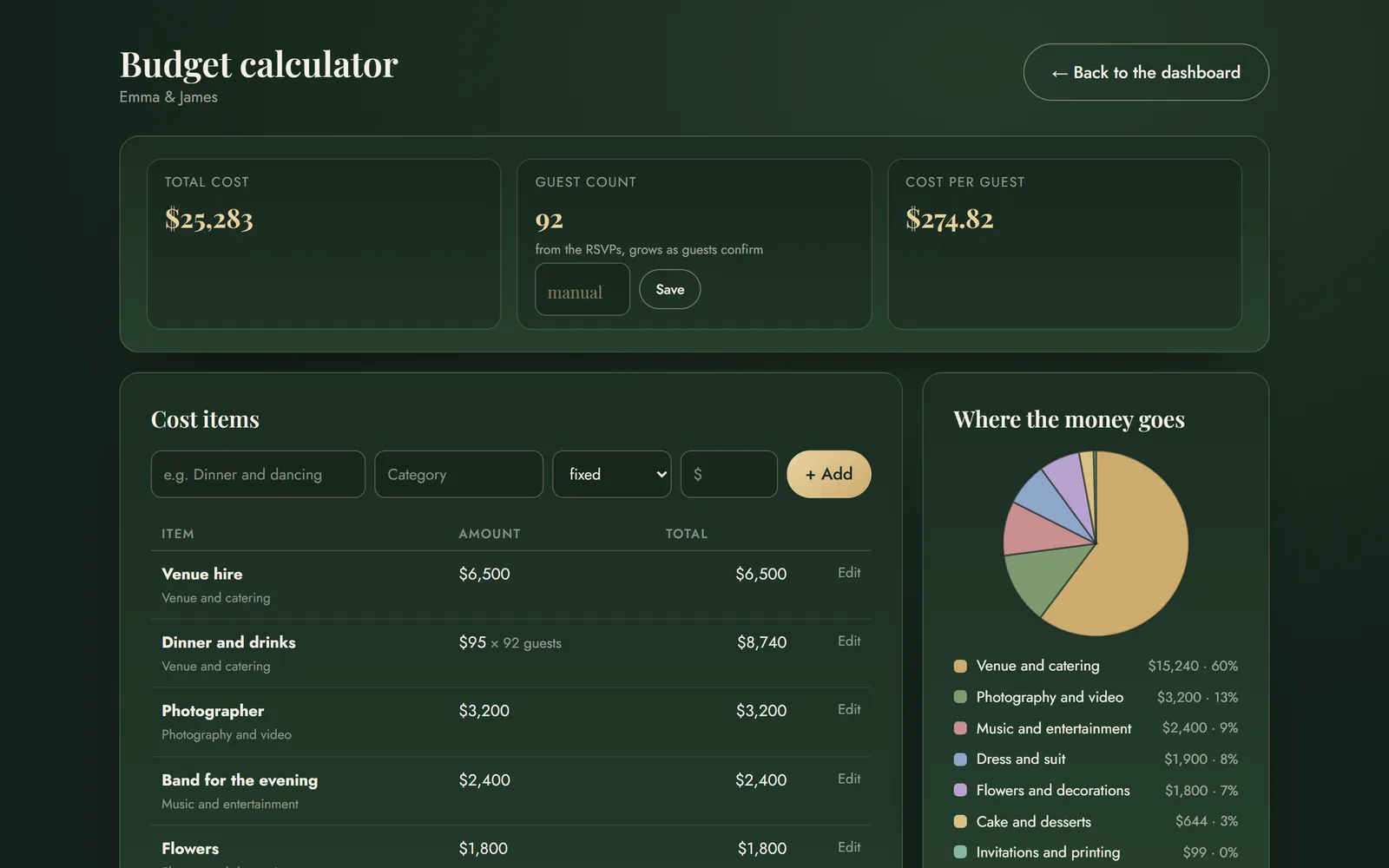
- Know your cost per guest: it turns the guest list into a priced decision.
- Track planned against actual from the first deposit, including the costs couples forget.
Wedding budgets do not fail because couples overspend on one thing. They fail because the guest count moves, and almost every large cost is multiplied by it.
So the most useful number in your budget is not the total. It is the cost per head, and once you know it, every decision about the guest list becomes a decision you can actually price.
Roughly how the money divides
- Venue, food and drink: around half of everything, sometimes more
- Photography and video: 10 to 15 percent
- Music: 5 to 10 percent
- Flowers and decoration: 5 to 10 percent
- Clothes, hair and make-up: 5 to 10 percent
- Stationery, favors and everything small: 5 percent
- Contingency: 10 percent, and you will use it
These proportions hold surprisingly well across very different budgets and very different countries. What changes is the total, not the shape.
Cost per head is the lever
Take everything that scales with guests (food, drink, place settings, favors, transport, the cake) and divide by the number of people. That figure is what one more guest costs you. Multiply it by the twenty names you are agonizing over and the guest list conversation changes character entirely.
It also works in the other direction. Cutting the guest list by fifteen people is usually the single largest saving available to you, and it is almost always less painful than any equivalent cut elsewhere.
The five costs couples forget
- Supplier meals: photographers and bands eat, and most contracts say you feed them
- Overtime: the band playing an extra hour is rarely free, and always decided at midnight
- Corkage, cake-cutting and service charges buried in the venue contract
- Tips and final payments, which need to exist in cash on the day
- Alterations: a dress is rarely the price on the tag once it fits
None of these are large individually. Together they are routinely five to eight percent of a wedding, which is exactly the contingency people talk themselves out of keeping.
Track planned against actual, from the first payment
A budget that only holds estimates tells you nothing after month three. Write what you thought it would cost and what it did cost side by side, from the first deposit. The gap between those two columns after four suppliers is the most accurate prediction you will get of the gap after twenty.
Where to spend, and where not to
Spend on what lasts and on what everyone experiences all evening: the photography, the food, the music, and the room itself. Save on what is looked at once: elaborate favors, printed menus at every place, anything that exists mainly to be photographed and thrown away.
Guests remember the food, the music and whether they had a good time. Almost nothing else on the budget survives a year in anyone's memory.
Common questions
How should a wedding budget be divided?
Roughly half on the venue, food and drink; 10 to 15 percent on photography; 5 to 10 percent each on music, flowers, and clothes and beauty; about 5 percent on stationery and small items; and 10 percent held back as contingency. These proportions hold across very different totals.
What is cost per head, and why does it matter?
It is everything that scales with guests (food, drink, place settings, favors, transport, cake) divided by the number of people. It tells you what one more guest actually costs, which turns the guest list from an emotional argument into a priced decision.
What costs do couples usually forget?
Supplier meals, overtime for the band, corkage and service charges in the venue contract, cash for tips and final payments, and dress alterations. Together these are commonly five to eight percent of the whole wedding.
Plan it all in one place
A seating chart, a budget and a checklist that follow your guests' replies, alongside your invitation.
Start planning free →